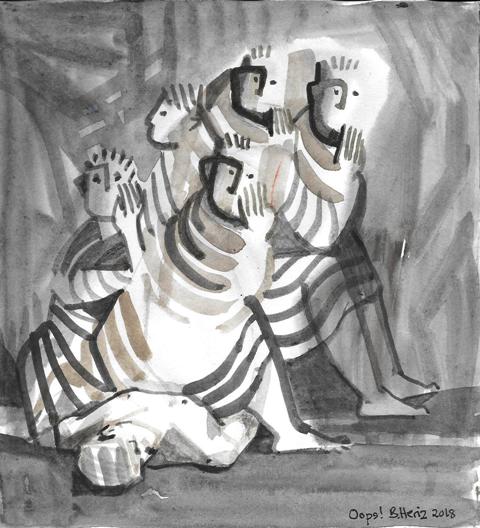
Oops! 2018
Watercolour, 20x18cm
After decades of postmodernist structuralism, cynical dishonesty practiced unabashed by certain political operators has become the norm. Is this the end result of Derrida's outrage at "the totalitarian arrogance implicit in the claims of reason"? Reason discarded? Derrida advocated the necessity of peeling away the layers of constructed meanings that Foucault saw as an alignment of knowledge and power to legitimise the symbolic order and its exclusion of "other".
And, over time, deconstruction of the symbolic order of patriarchy and colonialism has empowered the once excluded - third world activists, feminists, minorities, transgender, etc etc, underpinning argument and transforming political debate. If everything we believe is actually fiction, including the constructed narrative of 'self', then we are free to experiment with identities, explore alternatives.
But even so we must drill down vertically to examine or acknowledge the price, the sacrificed or denied, that enables each new construction. The 'enlightened' person should, presumably, hold his or her sense of self in a permeable relation to the 'out there', balancing the evidence of cause and effect against one's beliefs. It is a moral or intellectual discipline few can maintain. When it comes to one's own hopes and ambitions for status or affirmation, few are ready to expose 'the body hidden under the floorboard', as my brother Rupert's song goes. Our identities are fragile and we live in a socio-economic scenario that emphasises competitive individualism, not conscientious doubt.
There has been a negative to the good intentions of postmodernism. As Andre Gide narrated in
La Symphonie Pastorale, the road to hell is paved with good intentions. The authority of expert or professional analysis is easily dismissed in political debate as currently conducted by much of the media. It is all about identities now - tribes with different agendas set up in conflict against each other for maximum attention value. Media celebrities are frequently shown more respect than intellectuals, public servants, those with pragmatic experience, insight or skills. And, alarmingly, the deliberate telling of lies is accepted at the new 'norm'. People who challenge may be called treacherous, criminal, the no longer relevant 'entitled' elite, or whatever dismissive label suits purpose. And why not, if the symbolic order is to be defined as the voice of power?
It feels like the Englightenment era is over. But it might just be a hiccup. It might just signify the old symbolic order fighting for its life, with its deeply embedded patriarchy, its nationalism, racism, misogyny, climate change denial, and so on, showing its true and frightening colours.
It has been a disheartening time, but perhaps because the resistance has been so weak rather than surprise at the nastiness suddenly having the courage to openly declare itself.
And is the weakness perhaps because the 'liberal' left needs to do some deconstructing on itself? It has assumed a certain entitlement to virtue that probably needs some honest and courageous inspection. What lies denied beneath its own symbolic order? Just one example: there is proper outrage at the Russian cyber aggression to undermine the democratic process in the USA, but then it should be acknowledged that our governments on both the left and the right in USA and UK have long disrupted democratic process in many countries when it suited their economic interest to do so. Two wrongs don't make a right, but if we are to move towards cooperation rather than conflict, we surely need some introspection? The left assumes its entitlement to 'virtue, but it sits on many 'bodies' (for instance, the negative consequence materialism has had to the underprivileged under both left and right administrations). Surely this crisis is an opportunity to dig down to assess one's own taboos?
There are so many contradictions sitting on the horizon - the old Utopia of the left is clouded with dystopian apprehension. It is not that there is shortage of new ideas about how 'to be in the world', but with no cohesive political clout to support, develop and test, let alone apply them.
The application of reason was usefully questioned by postmodernism, but surely any resistance from the left requires more than its traditional assumptions to propose a fresh, rational and believable symbolic order?