Showing posts with label watercolour. Show all posts

Saturday, 17 February 2018

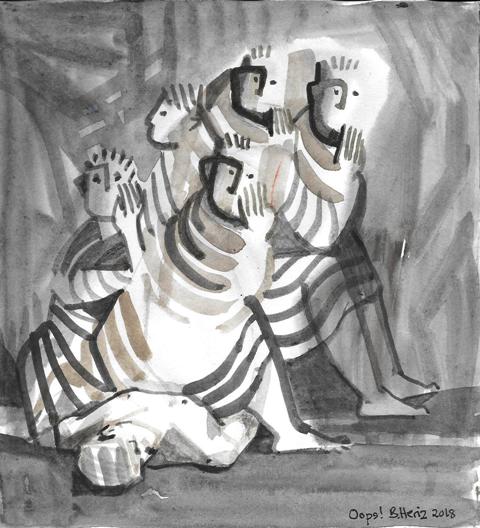
Oops!

Oops! 2018
Watercolour, 20x18cm


After decades of postmodernist structuralism, cynical dishonesty practiced unabashed by certain political operators has become the norm.  Is this the end result of Derrida's outrage at "the totalitarian arrogance implicit in the claims of reason"? Reason discarded? Derrida advocated the necessity of peeling away the layers of constructed meanings that Foucault saw as an alignment of knowledge and power to legitimise the symbolic order and its exclusion of "other".
And, over time, deconstruction of the symbolic order of patriarchy and colonialism has empowered the once excluded - third world activists, feminists, minorities, transgender, etc etc, underpinning argument and transforming political debate. If everything we believe is actually fiction,  including the constructed narrative of 'self', then we are free to experiment with identities, explore alternatives. 
But even so we must drill down vertically to examine or acknowledge the price, the sacrificed or denied, that enables each new construction. The 'enlightened' person should, presumably, hold his or her sense of self in a permeable relation to the 'out there', balancing the evidence of cause and effect against one's beliefs. It is a moral or intellectual discipline few can maintain. When it comes to one's own hopes and ambitions for status or affirmation, few are ready to expose 'the body hidden under the floorboard', as my brother Rupert's song goes. Our identities are fragile and we live in a socio-economic scenario that emphasises competitive individualism, not conscientious doubt.
There has been a negative to the good intentions of postmodernism. As Andre Gide narrated in La Symphonie Pastorale, the road to hell is paved with good intentions.  The authority of expert or professional analysis is easily dismissed in political debate as currently conducted by much of the media.  It is all about identities now - tribes with different agendas set up in conflict against each other for maximum attention value.  Media celebrities are frequently shown more respect than intellectuals, public servants, those with pragmatic experience, insight or skills. And, alarmingly, the deliberate telling of lies is accepted at the new 'norm'.  People who challenge may be called treacherous, criminal, the no longer relevant 'entitled' elite, or whatever dismissive label suits purpose. And why not, if the symbolic order is to be defined as the voice of power?
It feels like the Englightenment era is over. But it might just be a hiccup.  It might just signify the old symbolic order fighting for its life, with its deeply embedded patriarchy, its nationalism, racism, misogyny, climate change denial, and so on, showing its true and frightening colours.
It has been a disheartening time, but perhaps because the resistance  has been so weak rather than surprise at the nastiness suddenly having the courage to openly declare itself.
And is the weakness perhaps because the 'liberal' left needs to do some deconstructing on itself? It has assumed a certain entitlement to virtue that probably needs some honest and courageous inspection.  What lies denied beneath its own symbolic order?  Just one example: there is proper outrage at the Russian cyber aggression to undermine the democratic process in the USA, but then it should be acknowledged that  our governments on both the left and the right in USA and UK have long disrupted democratic process in many countries when it suited their economic interest to do so.  Two wrongs don't make a right, but if we are to move towards cooperation rather than conflict, we surely need some introspection? The left assumes its entitlement to 'virtue, but it sits on many 'bodies' (for instance, the negative consequence materialism has had to the underprivileged under both left and right administrations). Surely this crisis is an opportunity to dig down to assess one's own taboos?
There are so many contradictions sitting on the horizon - the old Utopia of the left is clouded with dystopian apprehension.  It is not that there is shortage of new ideas about how 'to be in the world', but with no cohesive political clout to support, develop and test, let alone apply them. 
The application of reason was usefully questioned by postmodernism, but surely any resistance from the left requires more than its traditional assumptions to propose a fresh, rational and believable symbolic order?

Friday, 16 February 2018

Trumpower

Trumpower, 2018
watercolour, 20x18cm


It was hard working creatively over 2017 though I carried on in the studio and continued to exhibit new work.  But it was a struggle. The usual spirit of resilience and regeneration which buoys up creative initiative was definitely at low ebb.  I know that throughout the long march of history, the majority of people have just wanted to get on with their lives as best as possible, being neither remarkably good nor bad and it is they that survive from one devastation to the next - they are the link between us and the past, not the warlords.  But it was hard last year not to feel a sense of despair, that the contradictions that support the narrative that holds us together in some sort of manageable order, of 'how to be in the world',  have pressed too close.  The edifice appears ominous and at breaking point. It doesn't feel like anything can be taken for granted at the moment.
Trump Tower is a good metaphor for the state of things - behind the glitter and show, dodgy financial transactions, Mafia connections, unethical practice, menace.  And all the lies and lies and lies!  Behind the glitter, a massive and soulless pile of concrete. No grace. Alienation.

Alienation in the City: Behind the Tower, 2018
Watercolour, 20x18cm

Sunday, 28 October 2012

Status and the professional class

    The Doubter, watercolour, 2012 

A wonderfully vindictive passage from Dickens in Our Mutual Friend, Chapter X, A Marriage Contract, describes the bridegroom who makes his living by investing his property in shares: "Where does he come from? Shares. Where he is going to? Shares. What are his tastes? Shares. Has he any principles? Shares. What squeezes him into Parliament? Shares. Perhaps he of himself never achieved success in anything, never originated anything, never produced anything! Sufficient answer to all: Shares. O mighty Shares!  To set those blaring images so high and to cause us small vermin, as under the influence of henbane or opium, to cry out night and day, 'Relieve us of our money, scatter it for us, buy us and sell us, ruin us, only we beseech ye take rank among the powers of the earth, and fatten on us!'"

Dicken's venom against the non-professional middle class seems particularly deep veined in this his last completed novel.  This little passage might speak powerfully to our embittered times,but elsewhere in the novel the overblown ridicule he bears upon the bourgeoisie is so cartoonish as to no longer function well as satire.  Rather it turns attention round upon Dickens himself.  The bile of his ridicule leaves a nasty taste, however much one sympathises with the rage he bears against those insoucient accumulators of wealth, power and influence.  His contempt is expressed, it seems to me, most forcefully towards poor aesthetic taste, this being a metaphor for moral deficit, or lack of imagination about or care for the plight of others in need.  This metaphorical connection is an imaginative construction, but not an obvious truth:  heightened aesthetic taste does not necessarily go in hand with a social conscience.

The use of such a metaphor might perhaps reflect upon the competition for status between those upstarts who have easily won investment capital and those that struggle for hard-earned intellectual or creative capital.  If so, it may shed light on Dicken's personal anxiety about attaining respectable social position.  Perhaps one of the worst crimes of the C19th nouveau riche was that they did not follow the example of the old aristocracy in seeking a display of magnificence through patronage of the creative and intellectual arts, one that bestowed glory upon those creative entrepreneurs who won favour.  The indifference of the more pragmatic nouveau riche obliged the creative sector to invent new methods of promoting their special status, one achieved elegantly by the next generation following on from Dickens in the invention of the 'avant-garde'.  But this is extensively and subtly explored in David Trotter's 'Paranoid Modernism' (Oxford 2001).  

Meanwhile, Dickens is always a wonderful read: it is always somewhat astonishing to discover in good C19th novels how issues of capitalism that are still relevant are portrayed with such clarity. 

Tuesday, 3 January 2012

Dissent and postmodernism


Dissent, watercolour and ink, 2011

It's not that I have any Utopian idea of how society might be perfectly organised - every society needs structure and in the shadows of every structure lurk the sacrifices made to achieve coherence: the resources exploited, what has been excluded or sublimated, the alternatives of how it might have been, the memory of what was there before and fears about what it might become! A shared belief in structural integrity is what enables us to conduct our social transactions in a more or less workable fashion. In not so good times, however, voices of dissent gather enough conviction to come out fighting from the shadows!

Saturday, 10 December 2011

Facing Hard Times


Alienation in the City, 2011

This watercolour is another of a series responding to the economic situation. The first image was included in the Out of the Box curated exhibition 'Facing Hard Times' in Kings Lynn earlier this year (see September blog). I wrote the following for the exhibition: "The banking crisis was sparked off by irresponsible financial operators, yet the sector seems more powerful than ever, profiting from the vulnerability that persists and dictating economic policy. Sometimes I wonder if the government's primary role now is to keep us acquiescent. International finance, symbolised in these works by the impersonal, inpenetrable facade of a city landscape, has no allegiance to place or population. The 'people' are anonymous to the financier, not citizens, but only consumers - just another resource to be milked or ditched. The alienation referred to is the cultural consequence of a single guiding principle: the generation of financial profit, regardless of consequences. But we roam the streets of this anonymous city landscape, guiltily complicit thanks to our mortgages, pensions, debts, investments, our benefits, our dependence on the bank for the everyday transactions of life."
The news yesterday that David Cameron walked away from EU negotiations because he could not get an agreement to protect the UK Finance Sector just confirms my fears. The cabinet says the government is protecting UK business, as if the only valid business in the UK is that of the finance sector. Agreed it has been allowed to grow out of all proportion in relation to other industries in this country, but isn't that exactly the problem? Surely what is required is unity amongst national governments in building up defences against the power that a rogue finance sector has accrued since deregulation?
I don't pretend to have any in-depth understanding of these matters, just the gut instincts of a non-comprehending outsider, to whom it looks like the Cabinet might be in the pocket of the City. And scanning up and down the street, it looks as if the elite of the art world might be quite comfortably at home here too.

Saturday, 24 September 2011

FACING HARD TIMES


Alienation in the City, 2, watercolour, 2011

My watercolour above is included in Facing Hard Times, an international exhibition presented by Out of the Box Independent Curators at Greyfriars Art Space, 43 St. James, Kings Lynn, Norfolk, PE30 5BZ from 3rd - 15th October, 2011, 10.00-17.00 hrs.
For more information about Out of the Box, go to http://www.facebook.com/OOTB.Curators.
