Monday, 25 June 2018

Rescription: for our Love of War

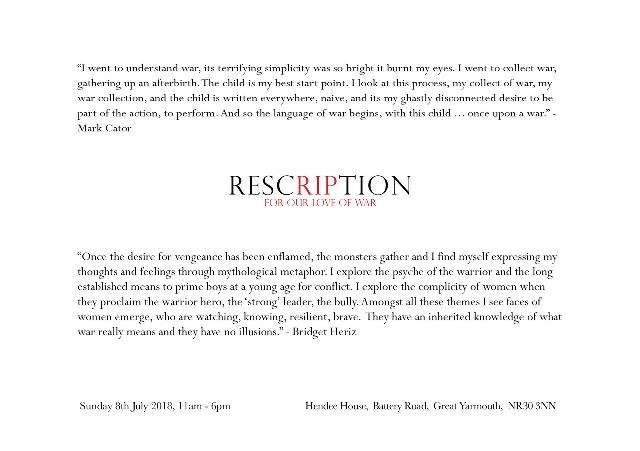
I am sharing an exhibition with the photographer and book publisher Mark Cator, to be held at his photography studio in the top floor of Hendee House, an industrial building in Battery Road, in the industrial area on South Denes, Great Yarmouth, Norfolk.  The exhibition is called Rescription: For Our Love of War.

Mark says "As artists we have both explored the relationship of war with the child  boy and the overall militarization of perceptions in society today."  My contribution has been selected from my War Diary sketchbooks and related work which I have been continuing since 1993 and most regularly since 2006.  This consists largely of studies undertaken in the evenings as a response to developments in conflict across the globe and in particular those that our government has participated in, in one way or another.  There is no consistent narrative to these studies: I just pick up my brush or pen and make a start, allowing and exploring whatever image emerges.  The drawings, watercolours and sculpture selected for this show relate to Mark's concerns.  The mythological Furies (or Avengers) aligned with military planes and the bully leader as war monger feature strongly.  There are also some works exploring the position of women as regards war.

The exhibition is open to the public for one day only, Sunday 8th July, 11am - 6pm.


Saturday, 17 February 2018

Bridget Heriz, Selwyn Taylor Publishing


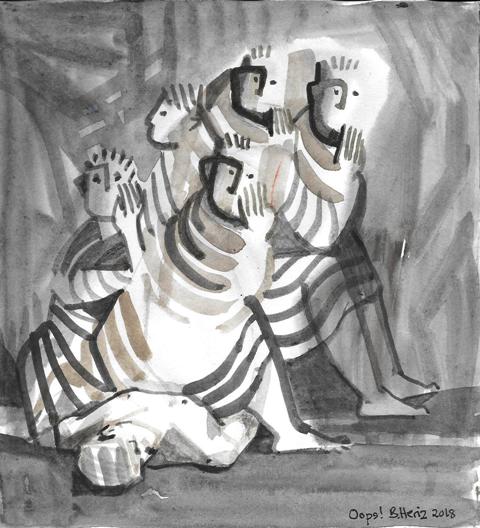
Oops!

Oops! 2018
Watercolour, 20x18cm


After decades of postmodernist structuralism, cynical dishonesty practiced unabashed by certain political operators has become the norm.  Is this the end result of Derrida's outrage at "the totalitarian arrogance implicit in the claims of reason"? Reason discarded? Derrida advocated the necessity of peeling away the layers of constructed meanings that Foucault saw as an alignment of knowledge and power to legitimise the symbolic order and its exclusion of "other".
And, over time, deconstruction of the symbolic order of patriarchy and colonialism has empowered the once excluded - third world activists, feminists, minorities, transgender, etc etc, underpinning argument and transforming political debate. If everything we believe is actually fiction,  including the constructed narrative of 'self', then we are free to experiment with identities, explore alternatives. 
But even so we must drill down vertically to examine or acknowledge the price, the sacrificed or denied, that enables each new construction. The 'enlightened' person should, presumably, hold his or her sense of self in a permeable relation to the 'out there', balancing the evidence of cause and effect against one's beliefs. It is a moral or intellectual discipline few can maintain. When it comes to one's own hopes and ambitions for status or affirmation, few are ready to expose 'the body hidden under the floorboard', as my brother Rupert's song goes. Our identities are fragile and we live in a socio-economic scenario that emphasises competitive individualism, not conscientious doubt.
There has been a negative to the good intentions of postmodernism. As Andre Gide narrated in La Symphonie Pastorale, the road to hell is paved with good intentions.  The authority of expert or professional analysis is easily dismissed in political debate as currently conducted by much of the media.  It is all about identities now - tribes with different agendas set up in conflict against each other for maximum attention value.  Media celebrities are frequently shown more respect than intellectuals, public servants, those with pragmatic experience, insight or skills. And, alarmingly, the deliberate telling of lies is accepted at the new 'norm'.  People who challenge may be called treacherous, criminal, the no longer relevant 'entitled' elite, or whatever dismissive label suits purpose. And why not, if the symbolic order is to be defined as the voice of power?
It feels like the Englightenment era is over. But it might just be a hiccup.  It might just signify the old symbolic order fighting for its life, with its deeply embedded patriarchy, its nationalism, racism, misogyny, climate change denial, and so on, showing its true and frightening colours.
It has been a disheartening time, but perhaps because the resistance  has been so weak rather than surprise at the nastiness suddenly having the courage to openly declare itself.
And is the weakness perhaps because the 'liberal' left needs to do some deconstructing on itself? It has assumed a certain entitlement to virtue that probably needs some honest and courageous inspection.  What lies denied beneath its own symbolic order?  Just one example: there is proper outrage at the Russian cyber aggression to undermine the democratic process in the USA, but then it should be acknowledged that  our governments on both the left and the right in USA and UK have long disrupted democratic process in many countries when it suited their economic interest to do so.  Two wrongs don't make a right, but if we are to move towards cooperation rather than conflict, we surely need some introspection? The left assumes its entitlement to 'virtue, but it sits on many 'bodies' (for instance, the negative consequence materialism has had to the underprivileged under both left and right administrations). Surely this crisis is an opportunity to dig down to assess one's own taboos?
There are so many contradictions sitting on the horizon - the old Utopia of the left is clouded with dystopian apprehension.  It is not that there is shortage of new ideas about how 'to be in the world', but with no cohesive political clout to support, develop and test, let alone apply them. 
The application of reason was usefully questioned by postmodernism, but surely any resistance from the left requires more than its traditional assumptions to propose a fresh, rational and believable symbolic order?

Friday, 16 February 2018

Trumpower

Trumpower, 2018
watercolour, 20x18cm


It was hard working creatively over 2017 though I carried on in the studio and continued to exhibit new work.  But it was a struggle. The usual spirit of resilience and regeneration which buoys up creative initiative was definitely at low ebb.  I know that throughout the long march of history, the majority of people have just wanted to get on with their lives as best as possible, being neither remarkably good nor bad and it is they that survive from one devastation to the next - they are the link between us and the past, not the warlords.  But it was hard last year not to feel a sense of despair, that the contradictions that support the narrative that holds us together in some sort of manageable order, of 'how to be in the world',  have pressed too close.  The edifice appears ominous and at breaking point. It doesn't feel like anything can be taken for granted at the moment.
Trump Tower is a good metaphor for the state of things - behind the glitter and show, dodgy financial transactions, Mafia connections, unethical practice, menace.  And all the lies and lies and lies!  Behind the glitter, a massive and soulless pile of concrete. No grace. Alienation.

Alienation in the City: Behind the Tower, 2018
Watercolour, 20x18cm

Thursday, 15 February 2018

Donald Trump and his Demons

Trump and his Demons, Jan 2018
"My button is bigger than yours"


It is as if I have been in a state of shock over the last year, as this new era unfolds where blatant lies, treachery and immoral acts are qualities awarded political gain where once they would have been career ending.  All successful politicians are necessarily cunning, but the performance of people like Donald Trump and Boris Johnson escapes the expected and understood boundaries of the capitalist democracies we thought we knew.  The buffoonery unashamedly acted out by Trump and Johnson is not an attempt to disguise ambition for power for it's own sake: that is plain for all to see.  They have a different cunning.  It is to "act in a way that is not immediately readable in order to gain an unfair advantage" - to quote Tim Parkes from Joe Queenan's subtle and compelling Radio 4 programme, A Brief History of Cunning, see www.bbc.co.uk/programmes/b09r37tz.
The fact that they hold no regard for any consequences to everybody else seems absolutely shocking to those of us who had perhaps become complacent about the checks and balances built into our democratic institutions.  Such extreme personality malfunction would normally have been judged too unstable to be accommodated at any serious level.  But it now seems to be approved by many as a sign of 'honesty'.
Perhaps that's the endgame of a long period in which individualism and materialism have been the most prominent factors and a culture of celebrity notoriety the prime signifier of success and affirmation. And of course, those whose employment prospects and well being have been so severely diminished by global capitalism are completely disenchanted with the traditional politicians, as they are with the entitled 'elite' who condoned austerity being imposed on the many to recoup financial losses incurred by the few in the 2008 banking crisis.  Preferable to have a wolf you can see than one hiding in sheep's clothing?
Except the particular demons that drive our special narcissists are not subdued by gains in power.  Surely a profound alienation and insecurity crouches deep within their essence, such that will drive even harder under the isolation of leadership?  No doubt the ego comes to believe that only absolute dominion will quell the demons, believing them to have outer cause rather than inner motor.  Everybody is viewed as hostile and a bullying divide and rule the only recourse.  Historically, such characters often self-destruct, but only after having created havoc all around.  Which is why Trump's boasting about the size of his nuclear button is chilling.

Saturday, 25 November 2017

Solo Show 'On Fifty Years of Art Making'


On 50 yrs of Art Making.....
Solo show at Skippings Gallery, 133 King Street, Great Yarmouth, Norfolk, UK.
9th - 16th December, 2017  11am - 4pm daily, except Sunday


  Running Figure, 2014, wood, 48 x 28 x 26 cm

BRIDGET HERIZ book launch, 7th December, 2017

Mandell's Gallery in Norwich are kindly hosting the launch of a new publication about my work, authored by Amanda Geitner, Director of East Anglia Art Fund, with an introduction written by Derek Morris, Fellow and former President, Royal British Society of Sculptors.
ISBN 978-1-5272-1263-3
Published in 2017 by Selwyn Taylor Ltd.


Sunday, 12 February 2017

Terracotta figurines, homage to nature


I have been creating little terracotta figurines for years.  They relate to a different creative place than my work constructed in wood and metal tube.  The figurines are small enough to be held and worked in the hand.   I have always found it hard to explain them to people, but with the increased sense of insecurity and threat in these troubled times, I have resolved to attempt to do so.

I find myself modelling these little figures in clay when I feel a need to pay homage to life: they are a prayer enacted through the modelling of clay.   "Please life, be resilient, stay strong, I have faith in you, no matter what predatory acts or abusive behaviour human beings display towards you."  

The sculptures are not intended to represent literal women, nor are they images of any particular divinity, though sometimes I may think of them as generic Earth Goddesses, metaphorical images of the natural world or of life on Earth.

The gift of life, of nature, has been expressed as 'female' over millennia - magnificent tiny female figurines were created by early Paleolithic peoples.  Such figurines have been found  in prehistoric sites all over the world.   I believe it is a human instinct, drummed out of us by the doctrine of  'the one and only true God (male)', a doctrine that confirmed patriarchy on the one hand and dominion over nature on the other.

My little figurines are often very round, like the fruits of nature so generously offered for our nourishment or like the miracle of Planet Earth itself.  They are tender in anatomical articulation, the form of shoulders, elbows, hips, hands, neck, are modelled with care to allow the eye to both 'feel' detail and to flow easily from part to part as a cohesive whole, front, back and sides. There is nothing of the brutalising simplification or stylisation of form that is the essence of modernism, for they are not expressions of self, nor totems of power.  Tenderness is not to be sentimental - nature's power is indifferent - it destroys as it creates.  Flesh seems too vulnerable to survive its hazards, but survive it does from generation to generation, creature to creature.  It is a miracle that never ceases to amaze. Tenderness is not to evoke human 'beauty', these are not fertility goddesses. They are not objects of erotic desire!  These figurines are worked to honour the natural world and that means on the one hand respecting the body, bone and flesh, and on the other to endow the form with inner vitality, independent to itself, as 'life' itself.  

I am blessed by the many birds that visit my garden. They are an inspiration, a hope, a comfort and an example.  Often my figurines are accompanied by a bird.  It is a prayer for the birds as representative of all forms of life. The suggestion is often that the presence of the bird is an honour, sometimes felt with some awe.  In Celtic mytholgy,  birds were closely related to ideas of the 'divine'.

Perhaps this motif is also a prayer for happy symbiosis between human beings and nature in general. It is my antidote to Trumpism, to climate change deniers, to corporate industries that bespoil environments and pollute the earth, to human greed which surveys nature in terms of material gain. It is my protest against the commodifying principal that lies at the base of our society, to our cruelty and arrogance.  It is my link across millennia to the earliest homo sapiens.  I would like to leave this homage to future generations as past generations left their indicators of the 'sacred' to us.  


Saturday, 22 October 2016

Millenial Muse Blues


MILLLENIAL MUSE BLUES

Forthcoming solo show of work by Bridget Heriz
29th October - 19th November 2016

Merchant House Gallery
102 High Street, Lowestoft, Suffolk NR32 1XW
www.merchanthousegallery.co.uk

Thurs-Sat 11am - 4pm, Tue-Wed by appointment

Wednesday, 17 August 2016

River Waveney Sculpture Trail

Cerridwen, or Metamorphosis, bronze, 36x13x12", 1990


This early sculpture of mine is being shown at the River Waveney Sculpture Trail at the River Waveney Study Centre (former Otter Trust), Old Harleston Road, Earsham, Bungay, NR35 2AF,
an idyllic setting for a sculpture trail, with lovely, peaceful walks along  waterways and wild flower meadows.  Curated by Dulcie Humphreys of the Fairhurst Gallery, Norwich, the trail has an interesting selection of work and is definitely worth a visit.  It is open until the 4th September 2016, Fridays, Saturdays, Sundays and Bank Holiday Monday, 10 am - 4 pm.

Waveney and Blyth Arts are offering a variety of events, including workshops, an audio-described walk, family fund day and a late night opening with barbecue.  See www.waveneyandblytharts.com.


Thursday, 17 March 2016

5th Anniversary of War in Syria

The Market Place, watercolour, 2016


Today is the 5th Anniversary of war in Syria, with nearly half a million dead and millions of people displaced, whole communities devastated and cultural heritage destroyed.  How can this monstrous atrocity be countenanced?

Migration of a people, watercolour, 2016

The Double

I have just finished reading Fyodor Dostoyevksy's surreal and sinister story "The Double", first published in 1846, this translation by Ronald Wilks, 2009.  I've read so much recently that was written in the 19th Century and seems totally pertinent to contemporary life.

Poor Mr. Golyadkin is trying to talk to his Civil Service employer, Anton Antonovich, regarding his anxieties about Mr. Golyadkin's double who has appeared in the workplace, an operator who knows how to insinuate himself with everybody to advance his interests.  

"I'm only developing the theory, putting forward the idea, Anton Antonovich, that people who wear masks aren't at all rare now and that nowadays it's hard to recognize the man beneath the mask".

"Well, you know, it's not so hard.  Sometimes it's even fairly easy, sometimes you don't have to look very hard...."

"No....I'm talking of myself, Anton Antonovish, I'm talking of myself, for example: when I say that I wear a mask, it's only when I need to; that is, only for carnivals or festive gatherings, speaking literally.  But I don't wear one every day in front of people, speaking in a different and more cryptic sense.  That's what I wanted to say, Anton Antonovich."

Golyadkin falls apart within a society where he feels he can trust no-one and is finally undone by his clever, dissembling double.  I think this ambiguous and disturbing text is a little masterpiece by Dostoyevky,


Masked in the City, watercolour, 2013

Saturday, 12 March 2016

Audrey Pilkington (1922-2015)

A celebratory exhibition of my mother's art.
Audrey Pilkington (1922-2015)
Skippings Gallery, 133 King Street, Great Yarmouth
9th April - 7th May 2016
Wednesday - Saturdays 11am - 4pm

Wednesday, 2 December 2015

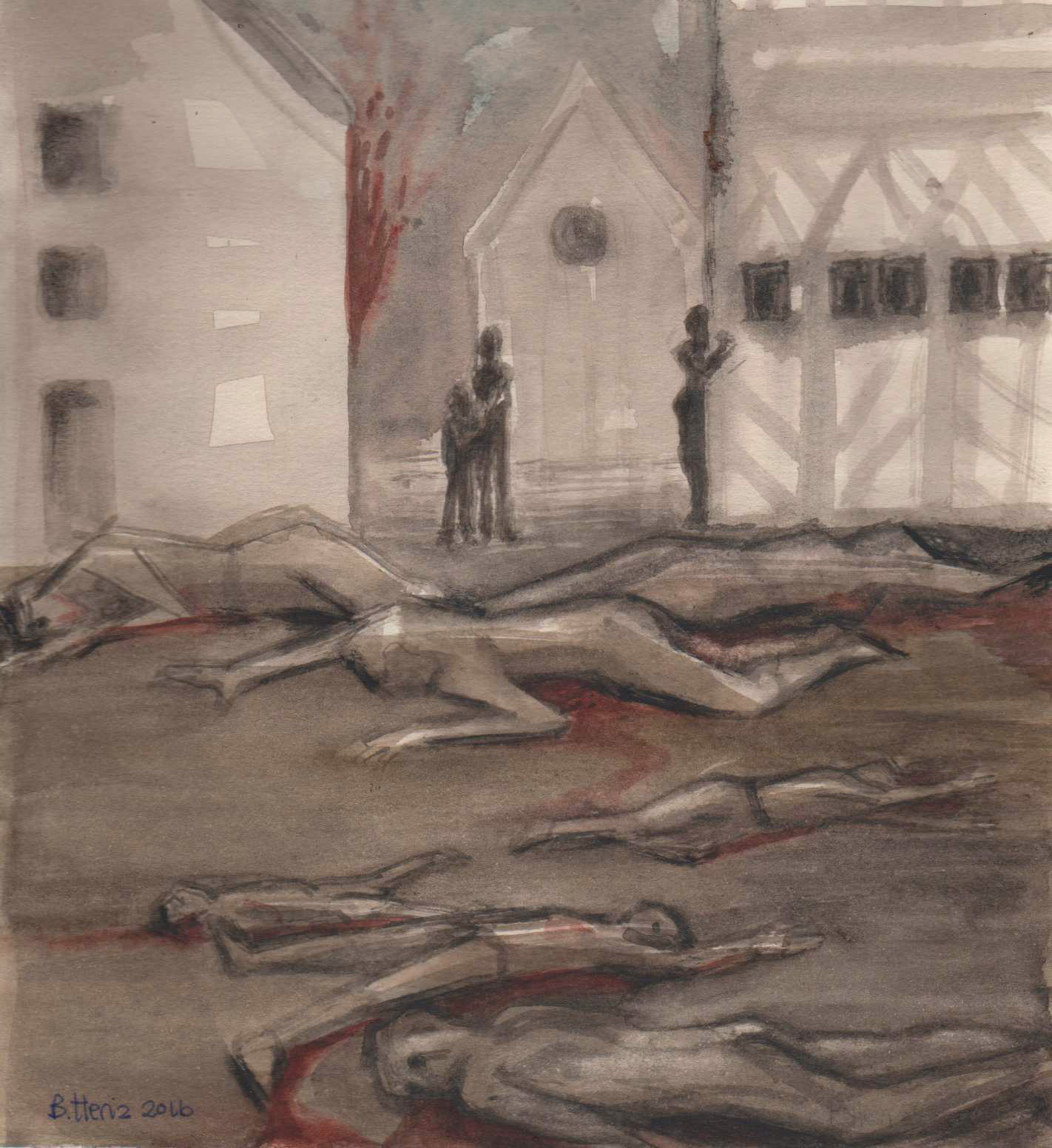
Hell on Earth


The Dead are in Peace, it is the Survivors who live in Hell, watercolour, 2015

Patrick Cockburn reported on 23rd October in London Review of Books, 5 Nov 2015 issue:

"According to the Syrian Observatory for Human Rights, 250,124 Syrians have been killed and an estimated two million injured out of a population of 22 million.  The country is saturated by violence."

Today the parliament in London has voted to take military action in Syria.  Russia, France, USA, Turkey, Iran, Saudi Arabia, Assad, the Kurds, Shia, Sunni, Israel, Palestine, etc etc etc., oil, coloniasm, arms sales, sadistic misogyny, greed, terror tactics, lies, evasions, propaganda - a different agenda for each party engaged, a whirlpool of confusion into which humanity is being hurled: for the civilians, blood and horror.

Friday, 20 November 2015

War Diary

I have been keeping a visual war diary for several years now, filling sketch books with watercolour or ink and wash drawings in response to the endlessly devastating news on television in the evenings.

It gets ever more impossible to respond in any way that remotely reflects the ruined lives of survivors from the increasing number of war zones, let alone the millions who have died.  But I feel I need to pay some sort of homage to the women and their families who have seen their homes and communities destroyed, and the injustice of modern warfare which brings so much suffering to non-combatants.


My homage does not pretend to express anything of the terrible reality on the ground, it can only be an outlet for my own grief at the indifferent brutality of man. My own soul wishes to flee from the horror of it all.  But there is nowhere to go: the world is a small place now and doesn't everything that happens on earth implicate us all everywhere?

There are more drawings on my website www.bridgetheriz.co.uk

Winter Shows 2015

I have work in several Winter Shows in regional galleries at the moment, including the Merchant House Gallery, Lowestoft.  Also the new Gallery in the Lanes, 25 Bedford Street, Norwich and in The Bank in Eye.

Friday, 4 September 2015

Jackson Pollock reviewed

There is an interesting review in the latest issue of Jackdaw (Sep/Oct 2015, No.123) of the Jackson Pollock's Black Paintings exhibition at the Tate Liverpool.  The reviewer is Alexander Adams, who explains how Pollock turned to black and to images of conflict, war and death as a riposte to the accusation of insubstantiality after negative criticism from his 1950 show at Betty Parsons Gallery.

"All the time Pollock painted the Black Paintings, he had to struggle with the problem of representation as seen through the prism of critical debates of the era.  How could an abstract  artist prove he had skill and seriousness without resorting to conventional figuration? ...... Pollock's ambivalence is here on the canvas in front of us.  Pollock was no sooner making images than he was veiling them.  He struggled with contrary impulses ;to make powerful imagery and prove his skill and a need to maintain his stance as a committed abstract artist." And further on in the text: "De Kooning's Women encompass ambiguities whille Pollock's figures have none: fear, flight, strife, suffering and death are at the centre and there is no periphery.  Examine his figure paintings from his earliest years up to his last, Portrait and a Dream, and you will find that the bleakness of Pollock's attitude towards humanity is unparalleled by any other great Western artist."

Interestingly, in a further article in the same issue of Jackdaw, Lynette Roth reviews the show of Max Beckmann paintings at the Saint Louis Art Museum.  She notes that "Beckmann's presence in America had a great impact on American painters, with his paintings widely reproduced and praised.  Beckmann's status as his own artist (meaning?) and an opponent of Nazi persecution meant he was lionised as an individual over and above his qualities as a painter.  Beckmann's presence in the USA is a critical (and largely overlooked) factor in the genesis of de Kooning's Woman series (starting 1950, and Pollock's Black Paintings (starting 1951).

I am not convinced about the last sentence in the quote above from the review of Pollock, but it was something else that struck me about these excellent reviews.  It was the artists' self-consciousness regarding their reception within the art establishment, not just in relation to self-promotion and status 'as an individual', but actually as a dictate over the inner creative voice.  The pressure of this tyranny no doubt mitigates against complacency and in  the work of de Kooning and Pollock it forged a dynamic of remarkable breadth and vigour. Great work was the result.

But to what extent and for how long can the creative imagination be restricted to the formulaic boundaries and performance criteria which theory and patronage demand?  What if the urgency of inner voice demands a 'retrograde' step?  Invention for invention's sake is theoretically approved and effective as marketing device, but isn't obedience to inner voice the real challenge and essence of creative renewal?

Thursday, 3 September 2015

Mother and Child in St. Mary's Church, North Tuddenham


St. Mary's Church in North Tuddenham is a fascinating church to visit, with a medieval painted rood screen in remarkable good condition, some medieval stained glass, and a unique Victorian decorative scheme. Definitely worth a visit!
I, along with five other artists, will be exhibiting work in the church over the weekend 12th and 13th September. The exhibition has been organised by the Friends group to raise awareness of the church and perhaps some restoration funds! 
Illustrated: Mother and Child, balsa wood, 2015

The Great Earth Goddess

Head of Inanna, cement,1994, by B Heriz


I was delighted to watch Dr Amanda Foreman's programme "The Ascent of Woman", shown on BBC4, 2nd September, in which she recounted with great clarity the high status of women in many aspects of pre-Hellenic society.   She  looked at the earliest human settlement in Turkey where there is no evidence of hierarchical difference between men and women, and where statuettes of the Great Earth Goddess abounded. (This is true also of the earliest settlements in Pakistan, as related by Sona Datta in her programme "Treasures of the Indus", BBC4, 31st August - good, old BBC!!!!)  

Even after the cult of warrior hero became dominant within communities obliged to allocate resources to defense, the enterprising and majestic Inanna was still worshiped by the Sumerians, for whom priestesses continued to play an important role and women had rights under law.

It was the Hellenic Greeks who invented the idea that the female sex was a different and inferior species to man, and as male property had no rights in law and no role in public life.  Women of citizen class were subject to the dictates of male "honour", a more precarious status I imagine than that even of mere slave. As such it was a necessity to wear shawls and veils when entering public space.  Women of lesser status were either actual slaves or prostitutes, and the latter were of course actually forbidden to wear shawls or veils.

Thanks to Alexander the Great and other factors, this concept bled into the cultures of the near east and from there was adopted by Islamic and Christian practice.  However, it was not fully embedded in the cultural norms of the northern Celtic societies, nor that of the Scythians, where women, in spite of the warring nature of their societies, remained significant players, had rights of inheritance and the ability to hold power.

These exceptions demonstrate how the delegation of women to inferior status was not an inevitable progression.  Yet it came to be believed that humanity is defined by the 'heroic' warrior ego able to realise a determination towards combat for supremacy, followed by entitlement to plunder all resources, human and natural, for its own benefit.  As clans, tribes, nations, and now whole continents compete for possession and control of resources, any group not geared up for war and competition has been and still is desperately vulnerable to pillage.   Nevertheless a yearning for alternative beliefs and aspirations has always existed and is it not stronger than ever, thanks to the environmental, economic, political and social challenges that  face us all on an international scale?

It is astonishing to think how it is only so recently that women (along with low-status men, serfs and slaves!) have gained the right to vote in the democracies of the West, have gained property rights, legal representation and 'permission' to play an openly public intellectual, creative and political role.  But when one considers the millennia over which the human species has evolved, even the last three thousand years is only a fleeting moment: the flexible human mind is surely capable of modifying its narratives, however deeply embedded they may be, and inventing new metaphors (and, indeed, new words) that can transform behaviour and attitudes.  The archetype of the Great Earth Goddess has potential surely for reimagination?

Thursday, 9 July 2015

Summer Show, Merchant House Gallery

   Foam-born, painted wood and copper tubing, h,70cm, 2015

I will be showing new work in the Summer Show at the Merchant House Gallery in Lowestoft.
18th July - 22nd August, open Tuesdays and Thursday - Saturday, 11am - 4pm.
102 High Street, Lowestoft, NR32 1XW.